

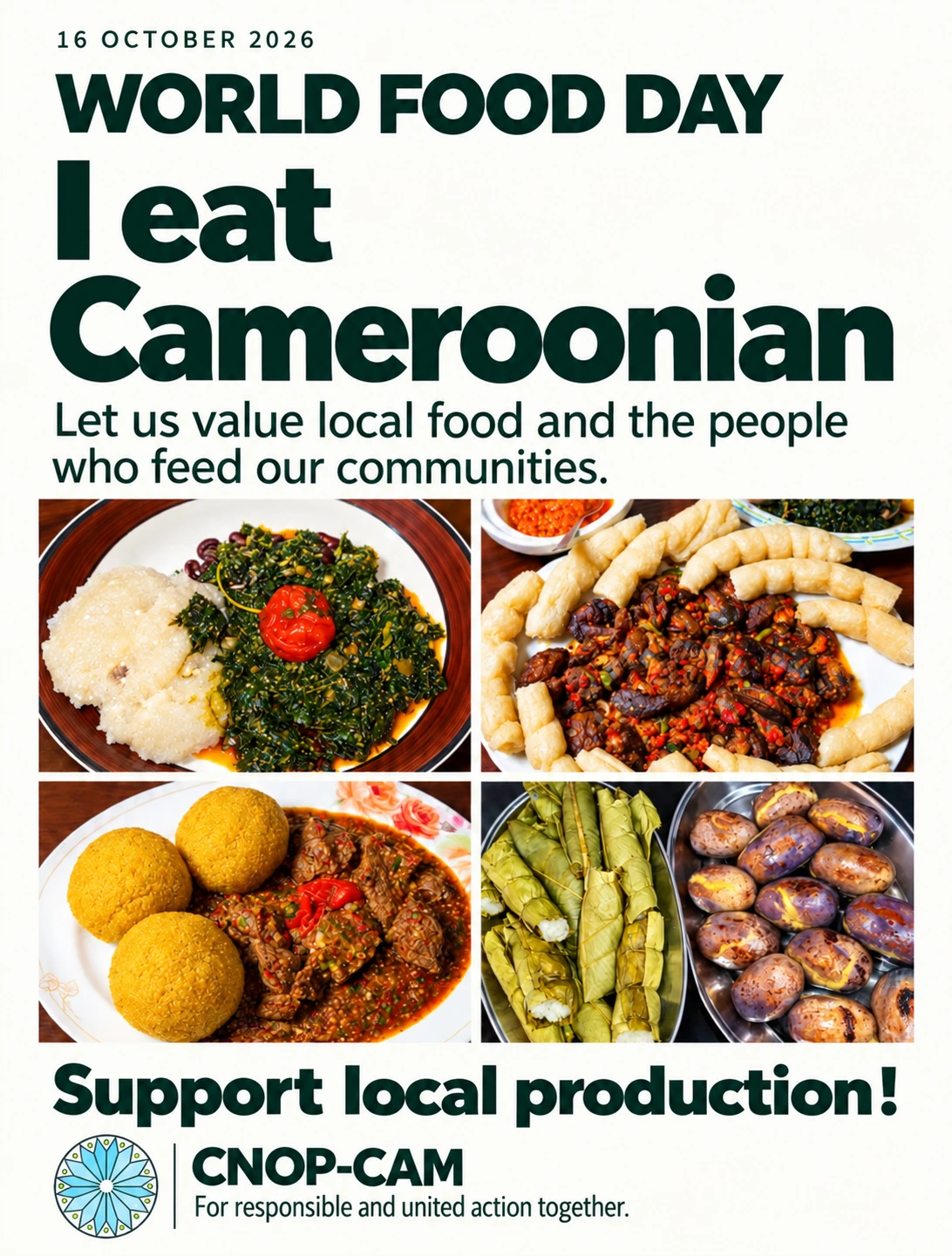
A plate of leafy greens, a cassava preparation, a maize dish or safou fruit: the diversity of our food reflects the diversity of our territories and knowledge. Behind each meal are women and men who produce, process, transport and sell. Celebrating local products also means recognising their work.
The message “I eat Cameroonian” links local consumption with support for rural communities. On World Food Day, CNOP-CAM calls for family farms to have the resources they need to feed people sustainably and earn a better living.
From our plates to family farms
Buying local products helps create outlets for farmers. Yet making the most of this production also depends on working conditions and how value chains are organised. Difficult access to finance, insufficient equipment, climate hazards and soil degradation constrain farming. Storage, processing and marketing difficulties further limit the value farmers can obtain from their harvests.
Supporting local food means acting across the chain: producing, storing, processing, transporting and selling. Families’ work should translate into more available food and more rewarding incomes.
Invest where the needs are
Access to water, suitable equipment, feeder roads, storage and processing facilities and advisory services are concrete priorities. CNOP-CAM calls for family farming to have a stronger place in public investment decisions and for farmers’ organisations to help define those decisions.
Their participation brings decisions closer to conditions on the ground, helps identify useful investments and supports implementation monitoring. Solutions need to be accessible, maintained over time and adapted to each territory.
Finance that respects agricultural cycles
Financing a season, acquiring equipment or storing a harvest requires resources that farms cannot always mobilise on their own. Repayment schedules and access conditions should reflect seasonal agricultural incomes.
CNOP-CAM advocates mechanisms suited to both individual activities and collective investment. Women and young people need better access to training, productive resources, equipment and decision-making, alongside finance.
Support farmers’ knowledge and innovation
Farmers’ organisations communicate needs, enable experience sharing and organise collective services. Strengthening them improves support for producers and dialogue with public authorities, researchers and development partners.
In Nkolmefou 1, in Cameroon’s Centre Region, farmers are experimenting with Tithonia diversifolia in cassava cultivation, with CNOP-CAM’s support and funding from the Agroecology Fund. The approach explores using locally available biomass as organic matter.
Effects in the plots concerned must be documented before recommendations for wider adoption are made. The experience shows why innovation needs advice, monitoring and time for evaluation under real farming conditions.
Three priorities for action
Invest in family farms: choose equipment, infrastructure and services with farmers, based on their needs.
Adapt finance: account for agricultural cycles and improve access for women, young people and collective initiatives.
Support advice and innovation: fund experimentation, assessment and knowledge sharing.
“I eat Cameroonian” can become a daily commitment to food, livelihoods and community. Consumers, public authorities, financial institutions and partners each have a role. Food system transformation must be built with farmers, starting from their needs and experience.